


Identify the format before interpreting the score
| Format | Standard innings structure | What needs context |
|---|---|---|
| T20 | Up to 20 overs per side | Powerplay, innings phase and wickets |
| ODI | Up to 50 overs per side | Longer innings and changing scoring pace |
| Test | Normally 2 innings per side | Match situation, time and possible draw |
Competition rules and interruptions can modify the practical schedule. A total of 160 has a different meaning in a T20 innings and in an ODI innings. A Test draw is also not simply another label for a tied score. Use the event’s official format and playing conditions rather than importing the assumptions of another tournament.
The same names can occur in senior, women’s, youth, domestic and international cricket. Confirm the participants and season, particularly when a search result or saved image is old. A generic cricket graphic is not a fixture confirmation.

Convert overs into legal deliveries
The dot separates overs and balls
At 14.3 overs, the innings has completed 14 overs and three valid deliveries. With six valid balls per over that is 87 balls, or 14.5 overs for arithmetic. It is not 14.3 decimal overs. Wides and no-balls affect the score but do not count as one of the six valid deliveries completing an over.
| Score notation | Valid balls | Overs for calculation |
|---|---|---|
| 6.0 | 36 | 6.0 |
| 10.2 | 62 | 10.333… |
| 14.3 | 87 | 14.5 |
| 19.5 | 119 | 19.833… |
If a side has 120 runs at 14.3 overs, its run rate is 120 ÷ 14.5, approximately 8.28 runs per over. Confusing the score notation with a decimal changes the calculation. For a player market, also distinguish runs credited to the batter from team extras: the team score and an individual’s score measure different things.
A required rate describes the chase, not its probability
Suppose the chasing side needs 61 runs from 42 valid balls. Seven overs remain, giving a required rate of 61 ÷ 7 = 8.71. If the next completed over produces 10 runs, the requirement becomes 51 from 36 balls: 8.50 per over. The equation updates after each delivery, but it does not include every sporting factor.
| Illustrative chase stage | Runs needed | Balls left | Required rate |
|---|---|---|---|
| Initial position | 61 | 42 | 8.71 |
| After a 10-run over | 51 | 36 | 8.50 |
| After a further 6-run over | 45 | 30 | 9.00 |
Wickets in hand, available batters, the bowling attack and conditions can make two numerically identical chases very different. A projection that multiplies the current rate by remaining overs is only arithmetic. It should not be presented as a reliable prediction or a guaranteed advantage over the market.

Match each market to its own settlement question
| Market | Sporting quantity | Rule needing attention |
|---|---|---|
| Match winner | Defined match result | Tie, Super Over and abandonment |
| Innings total | Runs in a named innings | Minimum completion and reduced overs |
| Batter runs | Individual credited runs | Participation and retirement |
| Phase total | Runs in specified overs | Exact starting and ending deliveries |
| Top scorer | Highest eligible player total | Ties and qualifying participants |
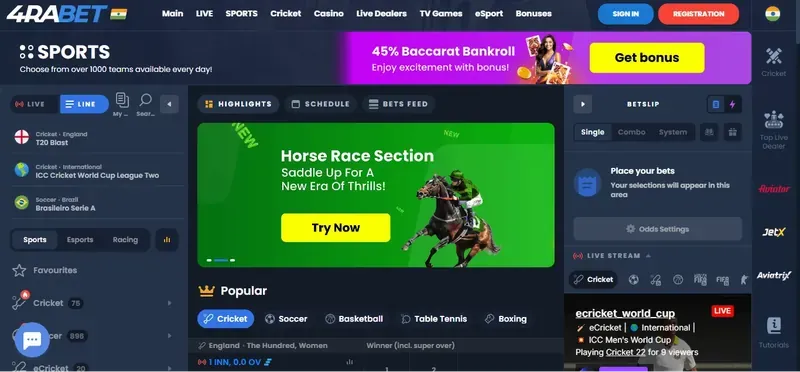
These are common cricket market categories, not a claim that every category is offered for every 4RABET fixture. A match can have an official winner while an innings-total selection is void under its particular rules. A player who does not participate can raise another settlement question. Read each selected market independently rather than applying the match result to all entries.
Keep the accepted wording
Save the event, innings or period, named player where applicable, accepted odds and reference. “Team won” is insufficient evidence for a dispute about a phase total. The sports guide explains returns and the difference between an accepted selection and a live price.
Rain changes the sporting target and may affect markets differently
For interrupted limited-overs cricket, the Duckworth–Lewis–Stern method is used under the applicable playing conditions to revise targets. The ICC explanation of DLS is the appropriate starting point. A revised target is not calculated simply by reducing the original target in proportion to the lost overs.
Wickets and remaining resources matter. The minimum play needed for a result can also depend on the competition and stage, so a blanket five-over or twenty-over claim is not sufficient for every event. Use the official revised target and result, then read the operator’s rules for the particular market. Sporting regulations and sportsbook settlement terms answer connected but different questions.
A weather forecast is not an abandonment decision. Likewise, a commentary feed describing an expected restart does not settle a wager. Keep the final official outcome and the accepted market record together.
Use a match-day information checklist
- Confirm the competition, season, teams and format.
- Check the official start time and convert to IST where necessary.
- Distinguish an announced squad from the confirmed playing XI.
- Read the toss, innings and any revised-overs notice in context.
- Keep live feed delay separate from the accepted market record.
- For a disputed outcome, retain the official result and exact market rule.
IPL coverage should be tied to the correct season and match; an old squad graphic is not a current line-up. Do not assume an animation is a live video stream or that every match offers identical markets. Cricket-themed crash games belong to the casino category, not real-match analysis. The India legal guide addresses access to money-gaming services separately from this explanation of the sport.
Questions answered
How many balls are 14.3 overs?
In the six-ball-over format it means 87 valid balls: 14 × 6 plus 3. For a run-rate calculation, use 14.5 overs.
Does rain void every market?
No universal answer applies. The official match result and each market’s completion and interruption rules must be considered separately.
Is the required rate a win probability?
No. It divides runs needed by overs remaining and does not account for all sporting circumstances.
Are cricket casino games IPL markets?
No. A themed instant game has its own game mechanics; a sportsbook market refers to a defined real sporting event.