
Separate a deposit minimum from an offer requirement
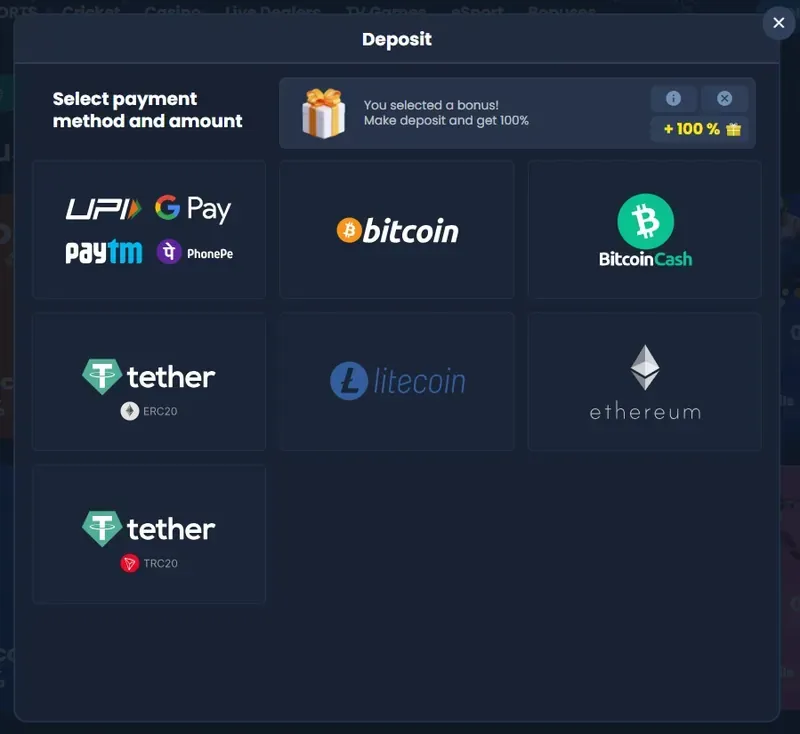
The public deposit page quotes different ranges for payment labels. Its UPI row begins at ₹100, while cards and local bank transfer begin at ₹500. Paytm and PhonePe labels are listed separately at ₹300, which is another reason not to treat the lowest advertised number as a universal minimum. These are published product figures; the India legal framework governs local eligibility independently.
| Published label | Minimum deposit | Maximum deposit |
|---|---|---|
| UPI | ₹100 | ₹100,000 |
| Cards | ₹500 | ₹100,000 |
| Bank transfer | ₹500 | ₹300,000 |
| Paytm | ₹300 | ₹70,000 |
| PhonePe | ₹300 | ₹50,000 |
A promotional requirement can differ again. For example, a payment above a method’s ordinary minimum may still fall below the qualifying amount in a particular bonus. Record the cash transaction and any promotion as separate entries; a combined balance cannot explain whether both were applied correctly.
Reconstruct four amounts before opening a case
Requested, debited, credited and returned
| Illustrative stage | Amount | Interpretation |
|---|---|---|
| Account payment order | ₹2,000 | Original requested cash amount |
| Posted bank debit | ₹2,000 | Money left the source |
| Account cash credit | ₹0 | No matching credit found yet |
| Later bank reversal | ₹2,000 | Money returned; reconcile the final position |
The table describes a possible missing-credit case, not a processing promise. A reversal changes the case: the customer may now be looking at a returned payment rather than money still held by the recipient. Check the final statement instead of relying on a notification saved earlier. If the amount was converted, retain the original currency and conversion timestamp rather than translating every entry using today’s exchange rate.
Use a six-step missing-credit checklist
- Open the original bank or wallet transaction, not just its notification.
- Record its final status, amount, currency, date and time.
- Copy the exact UTR or payment reference and the account’s payment-order ID.
- Look for a later reversal or a matching account credit under another timestamp.
- Send one clear case through an authenticated support channel with the relevant receipt.
- Save the response and follow the financial provider’s dispute process where applicable.
The public help centre describes processing that can take up to 24 hours and directs unresolved cases to support with identifying records. Treat that as published guidance, not a guaranteed deadline for every rail. A request to make a second “verification deposit” does not trace the first payment. Keep the issue attached to its original reference.
Distinguish two debits from two notifications
A duplicate alert is not necessarily a duplicate payment. Two posted debits with separate references are stronger evidence of two transactions. Build one row per reference, even when the amounts match. If only one payment credited, identify exactly which reference the receiving ledger matched. The remaining payment can then be investigated without ambiguity.
Expired orders need their own explanation
An account payment order can expire before a bank finishes processing. That does not automatically mean the bank transfer failed. Preserve the original order and ask whether the receiving side can allocate or return the money. Old QR codes and recipient details should not be treated as reusable instructions, especially when a private message supplies a replacement beneficiary.
Follow crypto from order ID to network record
A platform order ID and a blockchain transaction hash identify different stages. The sending exchange may first create an internal withdrawal ID, then publish a TxID after broadcast. Use an explorer for the actual network to compare asset, destination, quantity and status. Successful inclusion on-chain still has to be reconciled with the receiving account.
| Illustrative crypto entry | Quantity or value |
|---|---|
| Exchange debit | 25 USDT |
| Separate retained withdrawal charge | 1 USDT |
| Quantity reaching destination | 24 USDT |
| Example quote, not a live rate | ₹84 per USDT |
| Value before further deductions | ₹2,016 |
An unsupported network, a missing memo or a payment below the applicable receiving minimum can prevent ordinary crediting. Preserve the instructions and hash; recovery depends on the recipient’s technical access and process. Do not send another transfer to a stranger promising a reversal. The payment-method comparison explains networks and fee categories.

Ask for a resolution, not another payment
A concise support case states the original amount, date, reference and the discrepancy: for example, a ₹2,000 posted debit with no matching cash entry. Ask whether the recipient received it and whether the proposed resolution is credit or return. Do not describe an uncredited deposit as a withdrawal of winnings; that changes the factual question.
Keep passwords, OTPs, UPI PINs and recovery phrases out of every message. A request for remote access or an additional private “release fee” should be treated as a security issue. If the cash is already in the account but cannot be sent back, move to the withdrawal and balance guide with the transaction history. Preserve the original files even when you send a redacted copy.
Questions answered
What is the published UPI minimum?
The public deposit guide lists ₹100 for its UPI row. Other labels have different thresholds, and this does not establish current Indian availability.
Should I repeat an uncredited payment?
Trace the original reference first. Repeating it can create a second debit and a separate reconciliation problem.
What if the order expired?
Compare the bank’s final status with the expired order and ask the recipient to reconcile or return any received funds.
Which crypto identifiers are needed?
Keep the platform order ID, network, TxID, asset, quantity, destination and timestamp. An exchange’s internal ID alone may not show a broadcast transaction.