



Read the complete event record
Start with the sport, competition and participants. Similar team names can appear in senior, youth, reserve and virtual events. Next identify whether the market concerns the full match, a half, an innings, a set or another segment. Finally, read the selection wording and accepted decimal odds. A short label on a compact mobile screen may omit a condition visible in the detailed record.
- Event identity: competition, teams or players, and scheduled date.
- Market identity: winner, total, handicap or player-specific proposition.
- Result period: regulation time, a named phase or an expressly extended period.
- Accepted terms: selection, odds, stake and transaction reference.
Indian Standard Time is UTC+05:30. An overseas evening fixture can fall on the next Indian calendar day. Compare the interface’s timezone with the official fixture rather than treating two different date labels as an automatic scheduling error. The cricket guide adds the sport-specific details.
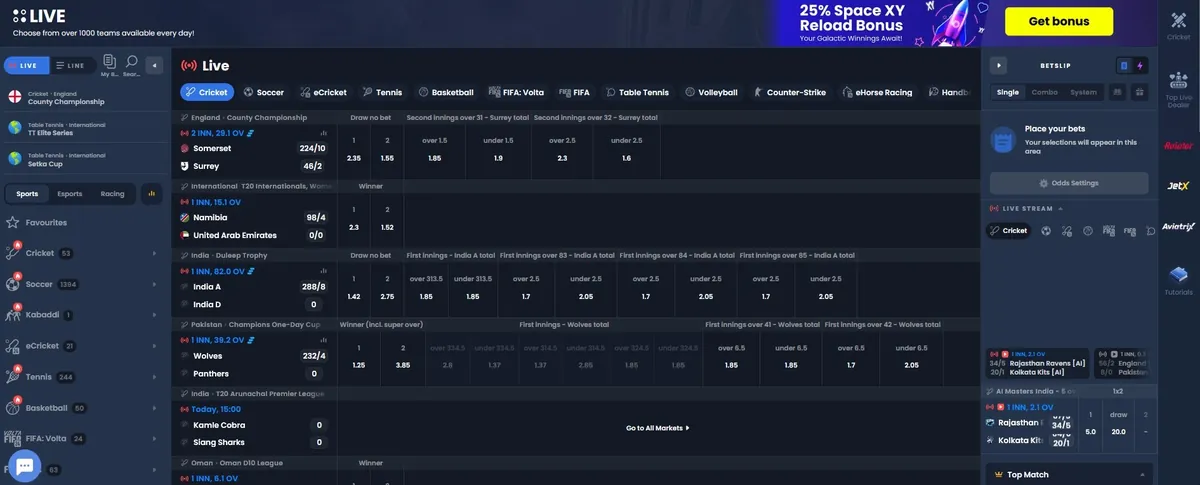
Decimal odds show total return, including the stake
| Example odds | ₹200 winning return | Profit within that return | Implied probability |
|---|---|---|---|
| 1.50 | ₹300 | ₹100 | 66.67% |
| 1.80 | ₹360 | ₹160 | 55.56% |
| 2.50 | ₹500 | ₹300 | 40.00% |
| 4.00 | ₹800 | ₹600 | 25.00% |
Total return equals stake × decimal odds. Profit is the return minus the original stake. Implied probability is 100 divided by the odds. The examples are mathematical illustrations rather than current prices or predictions. A losing single normally returns zero; voids, partial settlements and deductions depend on the market’s applicable rules.
Potential return is conditional
A slip showing ₹800 has not created an ₹800 balance. It describes the outcome if the selection wins and the terms are satisfied. The accepted price also matters: a price displayed before submission can differ from the price finally recorded. Keep the confirmation if the event is later disputed.
Compare market types before comparing prices
| Market example | What is measured | Possible point of confusion |
|---|---|---|
| Football match winner | Defined result period | Qualification and 90-minute winner differ |
| Total over 2.5 | At least 3 qualifying goals | Which period or team total applies |
| Whole-number total 3.0 | Result relative to 3 | Equality can trigger a push under the rules |
| Player statistic | Named recorded performance | Non-participation or retirement terms |
Two identical-looking prices are not comparable when the markets settle differently. A football team qualifying after extra time is not the same event as that team winning in regulation time. A player total can have participation requirements. A handicap adjusts the score or result before settlement; quarter-line products can split a stake between neighbouring lines and deserve their own explanation.
Use the exact market wording from the accepted record. Do not reconstruct it from a promotional tile or a social post after the match. The same principle applies to a free-bet promotion: qualifying odds and eligible markets are separate from the sporting result.


See how pricing margin changes the comparison
Consider a simplified two-outcome market priced at 1.90 for either side. Each side implies 52.63%, so the total is 105.26%. The 5.26 percentage points above 100 form the overround in this example. This is a way of describing the quoted market; it does not guarantee the operator the same profit on every match.
Short odds are not certainty
A 1.20 price implies approximately 83.33%, not 100%. The price reflects the market’s terms and pricing decisions, and it can move as information changes. Comparing prices should therefore begin with identical rules, timing and event identity. A shorter quote or a favourite’s recent winning run does not remove the chance of losing the stake.
Accumulators combine the conditions as well as the odds
| Illustrative combination | Combined odds | ₹100 total winning return |
|---|---|---|
| 2 selections at 2.00 | 4.00 | ₹400 |
| 3 selections at 2.00 | 8.00 | ₹800 |
| 4 selections at 2.00 | 16.00 | ₹1,600 |
For a simple accumulator, multiply the decimal odds. Every required leg must satisfy the settlement conditions. One losing leg normally defeats the entire combination, while void, push and partially settled legs follow the product rules. If three independent selections each had a true 50% chance, the chance of all three succeeding would be 12.5%, not 50%.
Related selections are not independent. A player scoring and their team winning can be connected, which is why same-event combinations need distinct pricing. A large potential return should be read alongside how many separate conditions must be fulfilled. It is not a measure of value by itself.

Keep live updates separate from the accepted record
A scoreboard, animation or video can lag behind the event. Markets may suspend during a goal, wicket or review, and any cash-out offer can change or disappear. An offer shown briefly is not a completed cash-out: the confirmation and ledger establish whether the action was accepted. Do not assume every event includes a live stream or early-exit feature.
- Save the bet or transaction reference.
- Keep the exact event and market wording.
- Record the accepted stake, odds and timestamp.
- Compare the official result with the applicable settlement rule.
- Submit a single factual query if the record appears inconsistent.
For account and transaction questions use the account-access guide and payment records. For Indian readers, descriptions of international sports products do not override the national legal restrictions. Cricket-themed casino games also remain separate from markets on actual cricket fixtures.
Decimal-odds return calculator
Illustrative inputs. This tool explains arithmetic, not a prediction or an account offer.

Questions answered
Do decimal returns include my stake?
Yes. A ₹200 winning stake at 2.50 returns ₹500 in total, including ₹200 originally staked.
Is a cash-out amount guaranteed?
No. Availability and price can change. Only the accepted confirmation establishes a completed action.
Why can the same team have different prices?
The markets may cover different result periods, qualification conditions or event segments, or the quotes may come from different times.
Is implied probability a prediction?
It is a calculation from the quoted price. It can include pricing margin and does not establish the true chance of the result.